


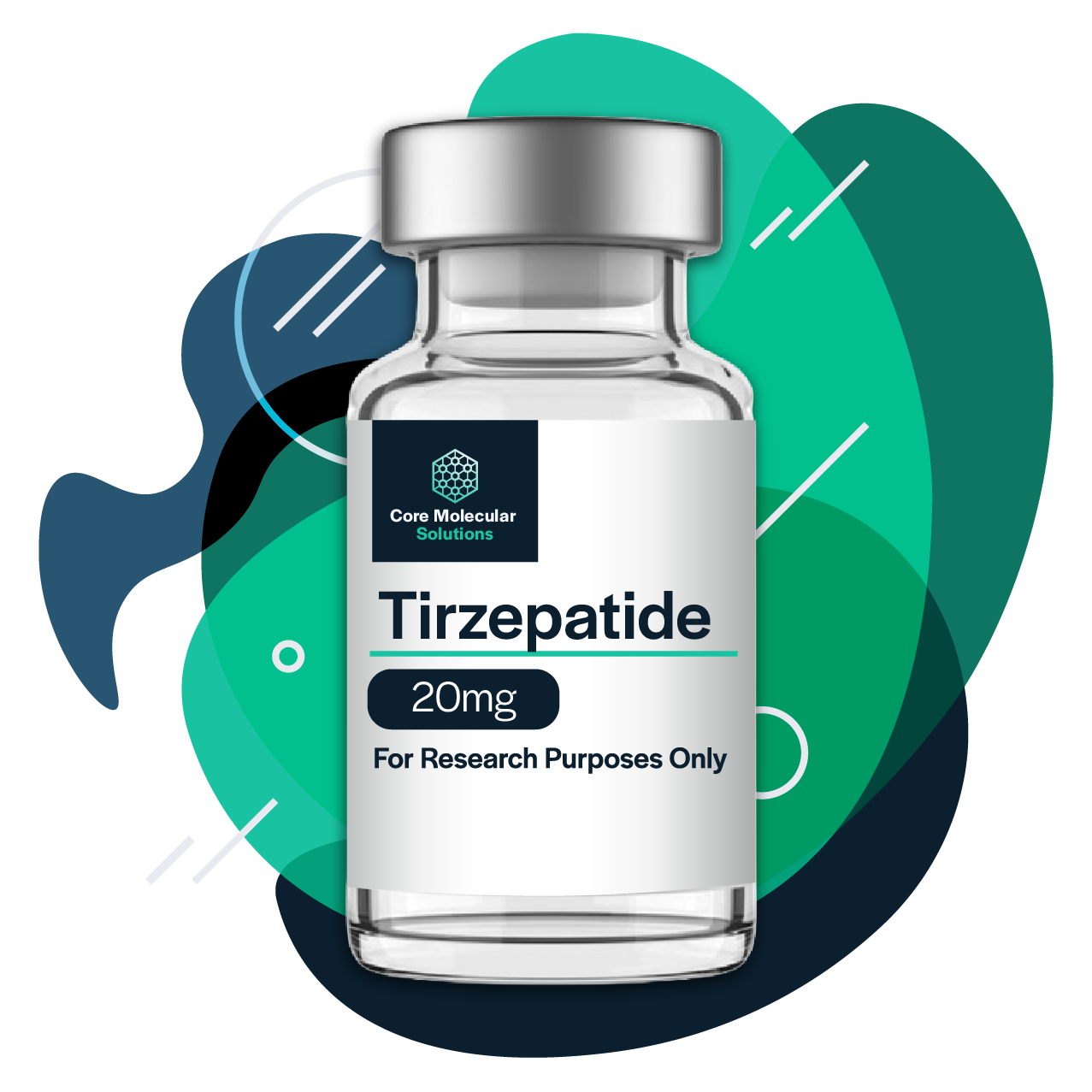
Tirzepatide
Price range: $50.00 through $130.00
GLP-1 / GIP Dual Receptor Agonist · 39-Amino-Acid Lipidated Peptide
Tirzepatide (LY3298176) is a synthetic 39-amino-acid peptide derivative engineered to concurrently activate both glucose-dependent insulinotropic polypeptide (GIP) and glucagon-like peptide-1 (GLP-1) receptors. Built upon an endogenous GIP sequence backbone, it incorporates non-canonical α-aminoisobutyric acid (Aib) residues alongside a C₂₀ fatty-diacid side chain attached to Lys²⁰ via a γGlu-γGlu linker. This acylation enables strong, reversible albumin binding, yielding an in vivo elimination half-life of approximately 5 days. Extensive literature from the SURPASS and SURMOUNT trial series (Frías et al., 2021; Jastreboff et al., 2022) details its dual-incretin receptor pharmacology, imbalanced agonism profiles, biased intracellular cAMP signaling, and combined impacts on glycemic dynamics and central anorectic pathways.
Supplied at 5mg.
Description
Overview
Tirzepatide is a synthetic 39-amino-acid linear peptide engineered to co-activate both glucose-dependent insulinotropic polypeptide (GIP) and glucagon-like peptide-1 (GLP-1) receptors. Based on the endogenous GIP backbone sequence, it incorporates non-canonical α-aminoisobutyric acid (Aib) substitutions alongside a lipidated side chain.
A C₂₀ fatty-diacid conjugated to Lys²⁰ via a γGlu-γGlu di-peptide linker promotes strong, reversible binding to circulating serum albumin, yielding an in vivo elimination half-life of approximately 5 days.
Key Technical Specifications
| Sequence | YXEGTFTSDYSIXLDKIAQKAFVQWLIAGGPSSGAPPPS-NH2(X = Aib; Lys20 conjugated to γGlu-γGlu-C20 diacid; C-terminal amide) |
|---|---|
| Molecular Formula | C₂₂₅H₃₄₈N₄₈O₆₈ |
| Molecular Weight | ~4813.5 g/mol |
| CAS Number | 2023788-19-2 |
| Elimination Half-Life | ~5 days (in vivo, human) |
| Solubility | Bacteriostatic Water / Sterile Water |
| Primary Class | Dual Incretin (GIP/GLP-1) Receptor Agonist |
Biochemical Architecture & Mechanisms
1. Imbalanced Dual-Receptor Signaling Profile
Tirzepatide exhibits differential activation kinetics across its target receptors: it acts as a full agonist at the GIP receptor while showing biased, lower-potency signaling at the GLP-1 receptor that favors intracellular cAMP generation over β-arrestin recruitment.
2. Structural Protection & Albumin Binding
Steric protection provided by Aib at positions 2 and 13 prevents metabolic degradation by Dipeptidyl Peptidase IV (DPP-IV). The C₂₀ diacid side chain creates a prolonged depot effect through reversible albumin conjugation, reducing renal clearance rates.
3. Physiological Pathways
- Insulin Secretion: Co-engages GIP and GLP-1 pathways on pancreatic beta cells to enhance glucose-dependent insulin secretion.
- Satiety & Motility: Modulates hypothalamic anorectic signaling and slows gastric emptying kinetics in research models.
Nomenclature Note: Secondary marketing literature sometimes mislabels Tirzepatide as “GLP-2.” However, Tirzepatide exhibits no binding activity at GLP-2 receptors; it is classified exclusively as a GIP/GLP-1 dual receptor agonist.
For laboratory research, educational, and analytical reference only. Strictly not for human or veterinary use.
Related products
-
GHK-Cu
Price range: $50.00 through $80.00 Select options This product has multiple variants. The options may be chosen on the product page -
CJC-1295 DAC
$140.00 Add to cart -
AOD-9604
$100.00 Add to cart -
TB-500
$130.00 Add to cart