

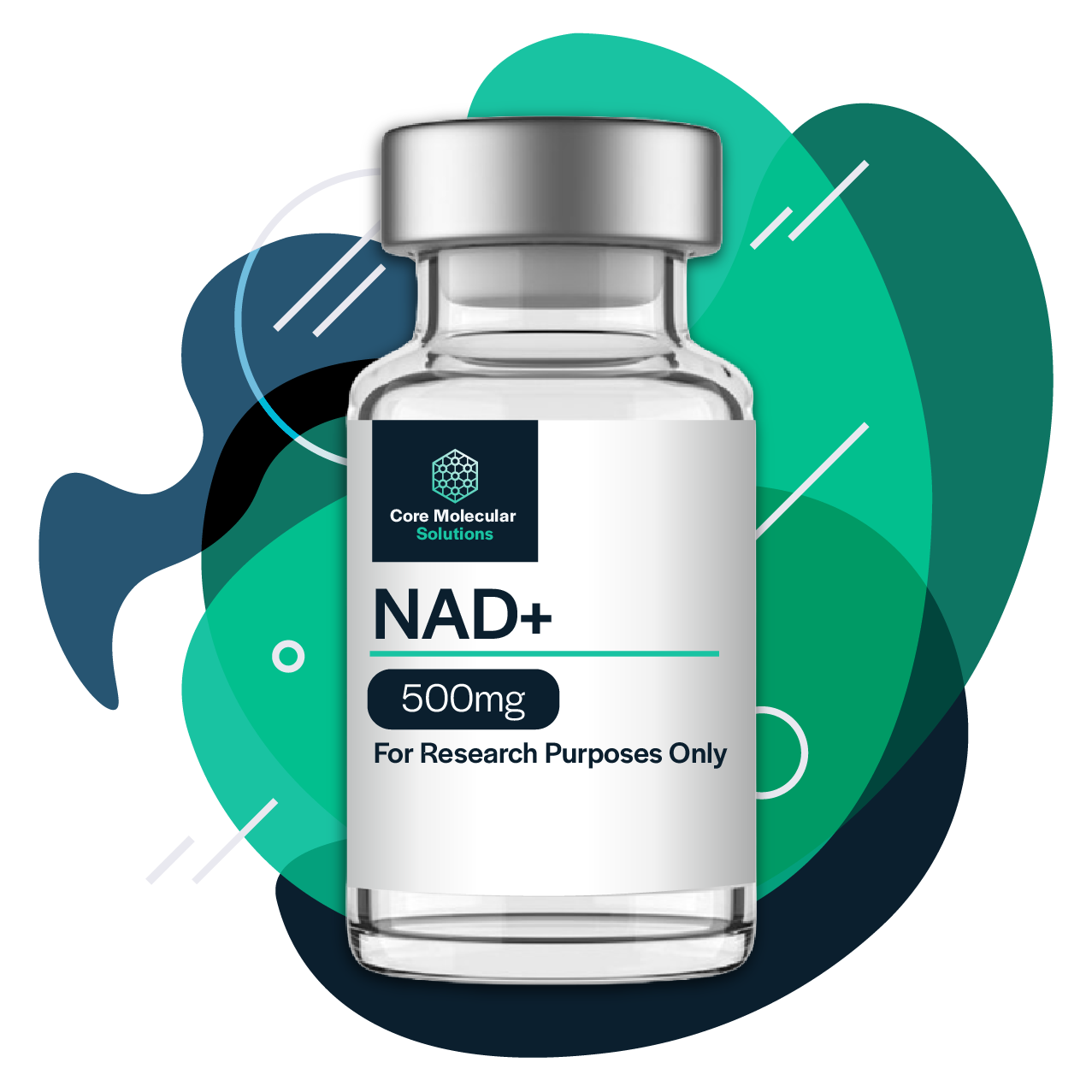
NAD+
Price range: $80.00 through $130.00
Nicotinamide Adenine Dinucleotide · Pyridine Coenzyme & Oxidative Phosphorylation Cofactor
NAD+ (Nicotinamide Adenine Dinucleotide) is an essential pyridine nucleotide coenzyme present in all living cells. Structurally composed of two ribose rings joined by a pyrophosphate linkage, with one ring attached to an adenine base and the other to a nicotinamide moiety, NAD+ is not a peptide but a critical organic cofactor. It acts as a primary electron acceptor in cellular redox reactions, cycling between its oxidized (NAD⁺) and reduced (NADH) states during glycolysis, the tricarboxylic acid (TCA) cycle, and mitochondrial oxidative phosphorylation. In addition to its role in cellular energy conversion, NAD+ serves as a rate-limiting substrate for NAD+-consuming enzymes, including sirtuins (SIRT1–7), poly(ADP-ribose) polymerases (PARPs), and cyclic ADP-ribose synthases (CD38/CD157), which regulate DNA repair, epigenetic gene silencing, mitochondrial biogenesis, and metabolic signaling pathways.
Supplied at 500mg and 1000mg.
Description
Overview
NAD+ (Nicotinamide Adenine Dinucleotide) is an essential dinucleotide coenzyme found in all living cells. Unlike peptide compounds, NAD+ is a small pyridine molecule that acts as a fundamental electron carrier in bioenergetic metabolic pathways.
In research models, NAD+ functions as a central cofactor for mitochondrial electron transport and ATP synthesis while serving as a consumed substrate for NAD+-dependent signaling enzymes, including sirtuins (SIRT1–7) and poly(ADP-ribose) polymerases (PARPs).
Key Technical Specifications
| Structure | Nicotinamide-ribose-pyrophosphate-ribose-adenine |
|---|---|
| Molecular Formula | C₂₁H₂₇N₇O₁₄P₂ |
| Molecular Weight | ~663.43 g/mol |
| CAS Number | 53-84-9 |
| Elimination Half-Life | Rapid intracellular enzymatic turnover |
| Solubility & Stability | Aqueous solutions / Bacteriostatic Water (pH- & light-sensitive) |
| Primary Class | Pyridine Dinucleotide Coenzyme / Bioenergetic Cofactor |
Biochemical Architecture & Primary Mechanisms
1. Metabolic Redox Shuttle
NAD+ accepts hydride ions (2e⁻ and H⁺) during glycolytic and TCA cycle reactions to yield reduced NADH. In turn, NADH shuttles electrons to Complex I of the electron transport chain to power mitochondrial ATP production.
2. Substrate for Signaling Enzymes
- Sirtuins (SIRT1–7): Consumed during deacetylation reactions that modulate epigenetic silencing, mitochondrial homeostasis, and oxidative stress response networks.
- PARP Activation: Utilized by poly(ADP-ribose) polymerases to initiate chromatin remodeling and recruit DNA repair complexes during genotoxic stress.
- Calcium Signaling: Acted upon by CD38/CD157 ecto-enzymes to produce cyclic ADP-ribose (cADPR), influencing intracellular calcium dynamics.
Handling Note: Reconstituted NAD+ in aqueous media is susceptible to temperature-dependent hydrolysis and degradation under alkaline or direct light conditions. Store solutions protected from light at reduced temperatures.
For laboratory research, educational, and analytical reference only. Strictly not for human or veterinary use.
Related products
-
TB-500
$130.00 Add to cart -
Semaglutide
Price range: $50.00 through $100.00 Select options This product has multiple variants. The options may be chosen on the product page -
GHK-Cu
Price range: $50.00 through $80.00 Select options This product has multiple variants. The options may be chosen on the product page -
Retatrutide
Price range: $150.00 through $200.00 Select options This product has multiple variants. The options may be chosen on the product page