


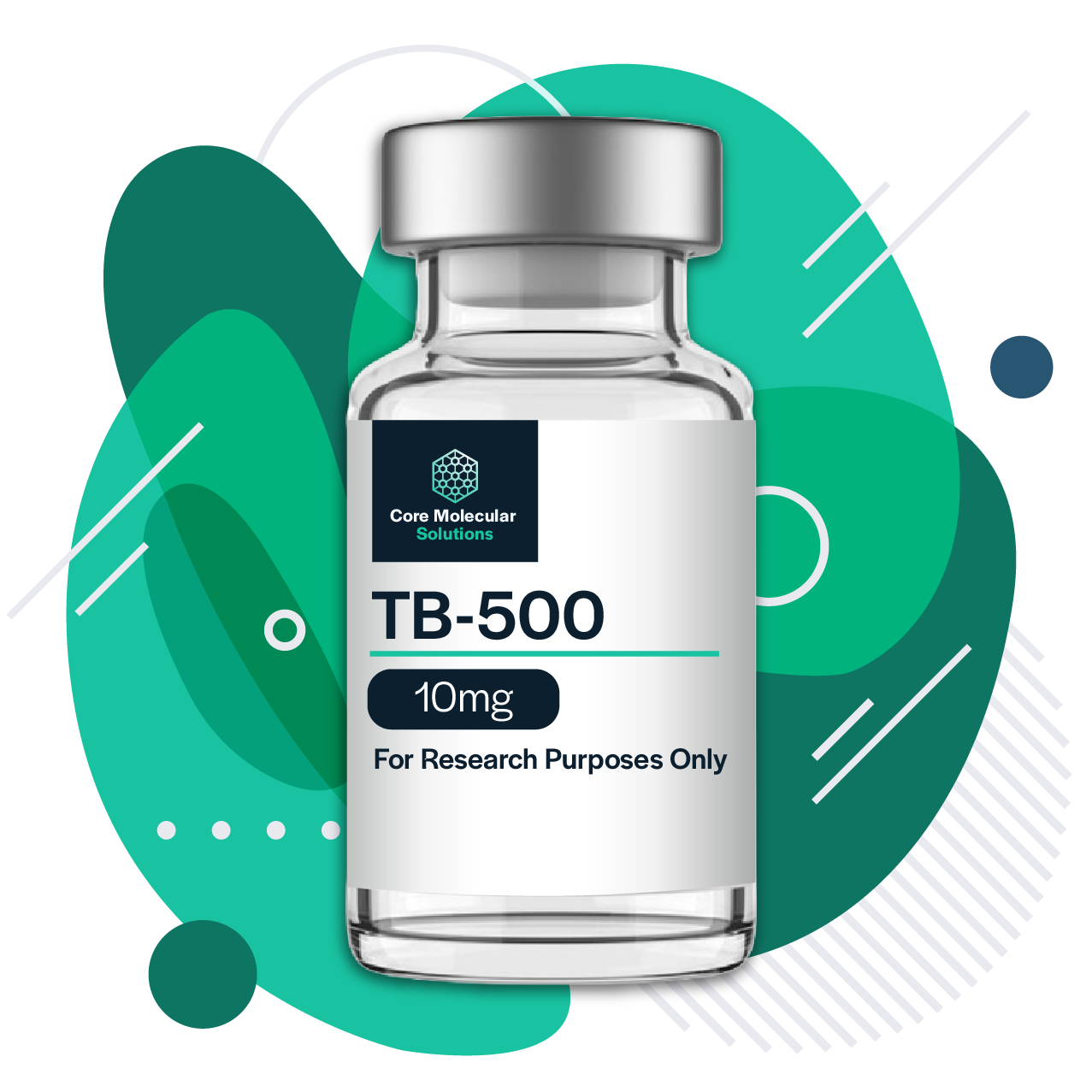
TB-500
$130.00
Thymosin β4 Active Fragment (17–23) · Acetylated Heptapeptide
TB-500 is a synthetic 7-amino-acid peptide fragment corresponding to the primary functional domain (residues 17–23) of the naturally occurring peptide Thymosin β4 (Tβ4). Modified with an N-terminal acetyl group (Ac-LKKTETQ-OH), TB-500 represents the central actin-binding motif responsible for regulating cytoskeletal assembly. Preclinical research evaluates its role in G-actin sequestration, actin polymerization kinetics (G-actin→F-actin dynamics), cell migration, and endothelial tube formation. Literature extensively documents its involvement in tissue repair pathways, dermal wound healing, cardiac remodeling models, and anti-inflammatory signaling cascades, as well as analytical detection methods in sports anti-doping assays.
Supplied at 10mg.
Description
Overview
TB-500 is a synthetic heptapeptide derivative comprising amino acids 17 to 23 of the naturally occurring 43-amino-acid protein Thymosin β-4 (Tβ4). Featuring an N-terminal acetylation (Ac-LKKTETQ), this short fragment isolates the active region responsible for binding monomeric actin.
In laboratory models, TB-500 regulates cytoskeletal dynamics, cell migration, extracellular matrix reorganization, and localized angiogenesis without requiring the full-length protein sequence.
Key Technical Specifications
| Sequence | Ac-LKKTETQ-OH(N-Acetyl-Leu-Lys-Lys-Thr-Glu-Thr-Gln) |
|---|---|
| Molecular Formula | C₃₈H₆₈N₁₀O₁₄ |
| Molecular Weight | ~889.02 g/mol |
| CAS Number | 885340-08-9 |
| Solubility | Bacteriostatic Water / Sterile Water |
| Primary Class | Actin-Sequestration & Cytoskeletal Modulator |
Biochemical Architecture & Mechanisms
1. G-Actin Sequestration & Cytoskeletal Assembly
TB-500 interacts directly with cellular structural components:
- Actin Dynamics: Binds monomeric G-actin to maintain a pool of precursors required for microfilament assembly (F-actin), directly controlling cellular motility.
- Cellular Migration: Promotes directional movement of dermal fibroblasts, keratinocytes, and endothelial cells toward tissue regeneration zones.
2. Angiogenesis & Extracellular Matrix Repair
Supports microvascular structure and tissue remodeling:
- Vascular Tube Formation: Stimulates endothelial cell differentiation, facilitating new capillary outgrowth in damaged tissue models.
- Matrix Regulation: Modulates collagen deposition and matrix metalloproteinase pathways to minimize fibrotic scar tissue formation.
Analytical & Detection Standard: Due to its distinct small-molecule structure, TB-500 is extensively utilized in research environments as a reference standard for developing mass spectrometry (LC-MS/MS) anti-doping detection methodologies.
For laboratory research, educational, and analytical reference only. Strictly not for human or veterinary use.
Related products
-
NAD+
Price range: $80.00 through $130.00 Select options This product has multiple variants. The options may be chosen on the product page -

Retatrutide
Price range: $150.00 through $200.00 Select options This product has multiple variants. The options may be chosen on the product page -

BPC-157
$70.00 Add to cart -
CJC-1295 DAC
$140.00 Add to cart