


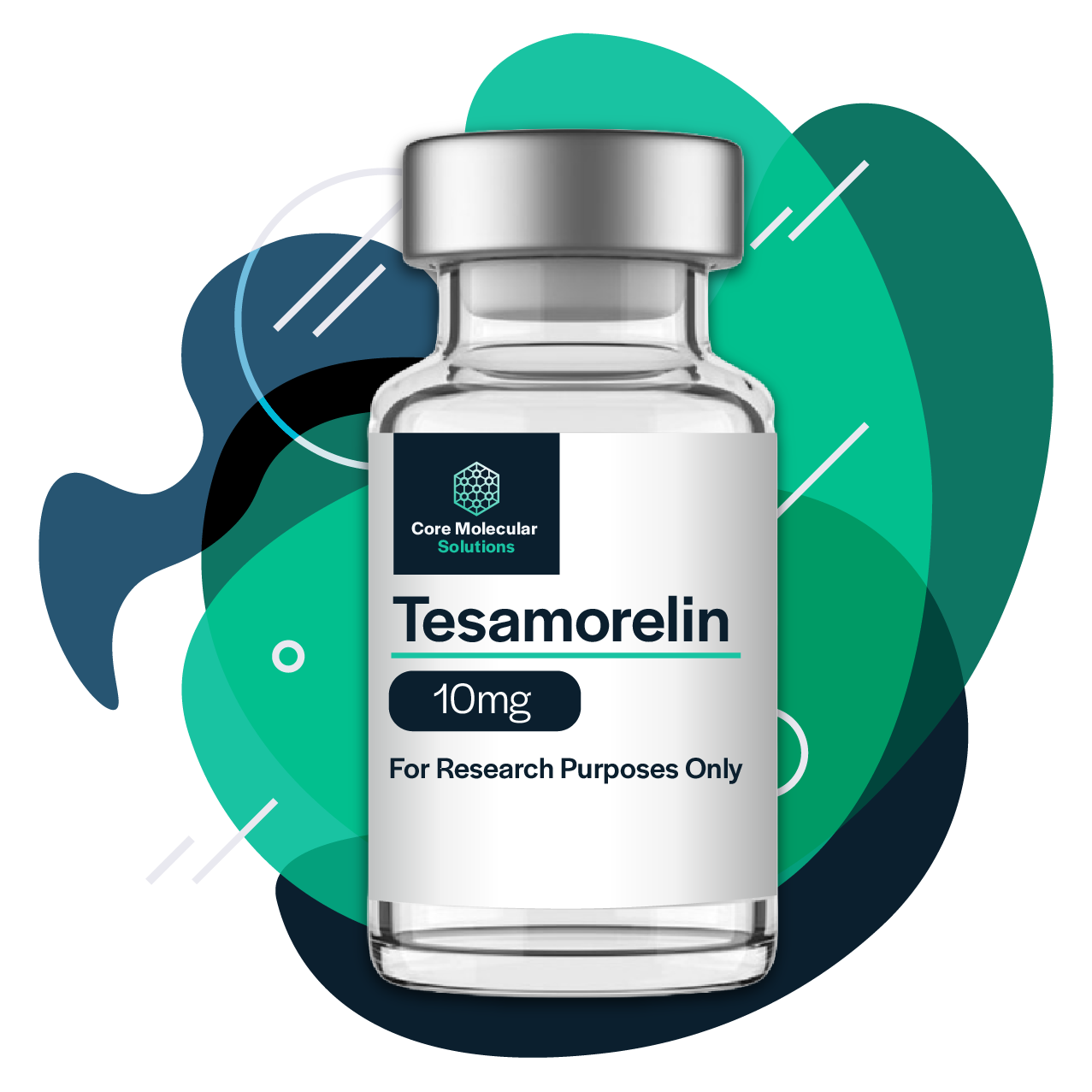
Tesamorelin
Price range: $130.00 through $200.00
Stabilized GHRH Analog · trans-3-Hexenoyl Conjugate
Tesamorelin is a synthetic 44-amino-acid peptide derivative of human Growth Hormone-Releasing Hormone (GHRH₁–₄₄). Modified at its N-terminus via the conjugation of a trans-3-hexenoyl fatty-acid group, Tesamorelin is specifically engineered to resist enzymatic degradation by Dipeptidyl Peptidase IV (DPP-IV). This structural modification prolongs its systemic plasma half-life relative to native GHRH and sermorelin. Landmark clinical literature (Falutz et al., 2007, 2010 NEJM; Stanley et al., 2014) documents its highly selective binding to GHRH receptors on anterior pituitary somatotrophs, driving the pulsatile release of endogenous Growth Hormone (GH) and subsequent synthesis of Insulin-like Growth Factor 1 (IGF-1), with primary research applications focused on visceral adipose tissue (VAT) depletion and hepatic lipid dynamics.
Supplied at 10mg and 20mg.
Description
Overview
Tesamorelin is a synthetic 44-amino-acid derivative of human Growth Hormone-Releasing Hormone (GHRH₁–₄₄). Engineered with an N-terminal trans-3-hexenoyl fatty-acid group, it resists rapid cleavage by Dipeptidyl Peptidase IV (DPP-IV), conferring an extended elimination half-life relative to endogenous GHRH and shorter analogs like sermorelin.
In research settings, Tesamorelin selectively stimulates pituitary GHRH receptors to drive the natural, pulsatile secretion of endogenous Growth Hormone (GH) and Insulin-like Growth Factor 1 (IGF-1), leading to targeted visceral fat oxidation and lipid clearance.
Key Technical Specifications
| Sequence | trans-3-hexenoyl-YADAIFTNSYRKVLGQLSARKLLQDIMSRQQGESNQERGARARL-NH2(N-terminal trans-3-hexenoyl modification; C-terminal amide) |
|---|---|
| Molecular Formula | C₂₂₁H₃₆₆N₇₂O₆₇S |
| Molecular Weight | ~5135.86 g/mol |
| CAS Number | 218949-48-5 |
| Elimination Half-Life | ~26 min (in vivo, human subcutaneous) |
| Solubility | Bacteriostatic Water / Sterile Water |
| Primary Class | Growth Hormone-Releasing Hormone (GHRH) Agonist |
Biochemical Architecture & Mechanisms
1. Metabolic Stability & Enzyme Protection
Native GHRH is degraded rapidly at the Tyr¹-Ala² linkage by circulating DPP-IV. Conjugating a trans-3-hexenoyl lipophilic tail onto Tyr¹ protects the core N-terminus through steric hindrance, delaying metabolic clearance while maintaining high binding potency at GHRH receptors.
2. Somatotrophic Signaling & Feedback Control
Tesamorelin activates GHRH receptors on anterior pituitary somatotrophs, initiating cAMP downstream cascades:
- Pulsatile Release: Preserves endogenous somatostatin regulatory loops, inducing natural, pulsatile growth hormone surges.
- IGF-1 Axis: Promotes downstream hepatic expression and release of systemic Insulin-like Growth Factor 1.
3. Visceral Adiposity & Lipid Dynamics
- Visceral Lipolysis: Selectively stimulates visceral adipose tissue breakdown via β₃-adrenergic activity without depleting subcutaneous lipid stores.
- Triglyceride Regulation: Demonstrates marked reductions in liver fat content and systemic triglycerides in metabolic research literature.
Clinical Trial Literature: FDA-approved in 2010 for HIV-associated lipodystrophy, Tesamorelin’s therapeutic mechanism has been extensively documented in clinical research (Falutz et al., 2007, 2010; Stanley et al., 2014), showcasing profound effects on visceral adiposity reduction and hepatic steatosis models.
For laboratory research, educational, and analytical reference only. Strictly not for human or veterinary use.
Related products
-
AOD-9604
$100.00 Add to cart -

Tirzepatide
Price range: $50.00 through $130.00 Select options This product has multiple variants. The options may be chosen on the product page -
NAD+
Price range: $80.00 through $130.00 Select options This product has multiple variants. The options may be chosen on the product page -

5-AMINO-1MQ
$45.00 Add to cart