


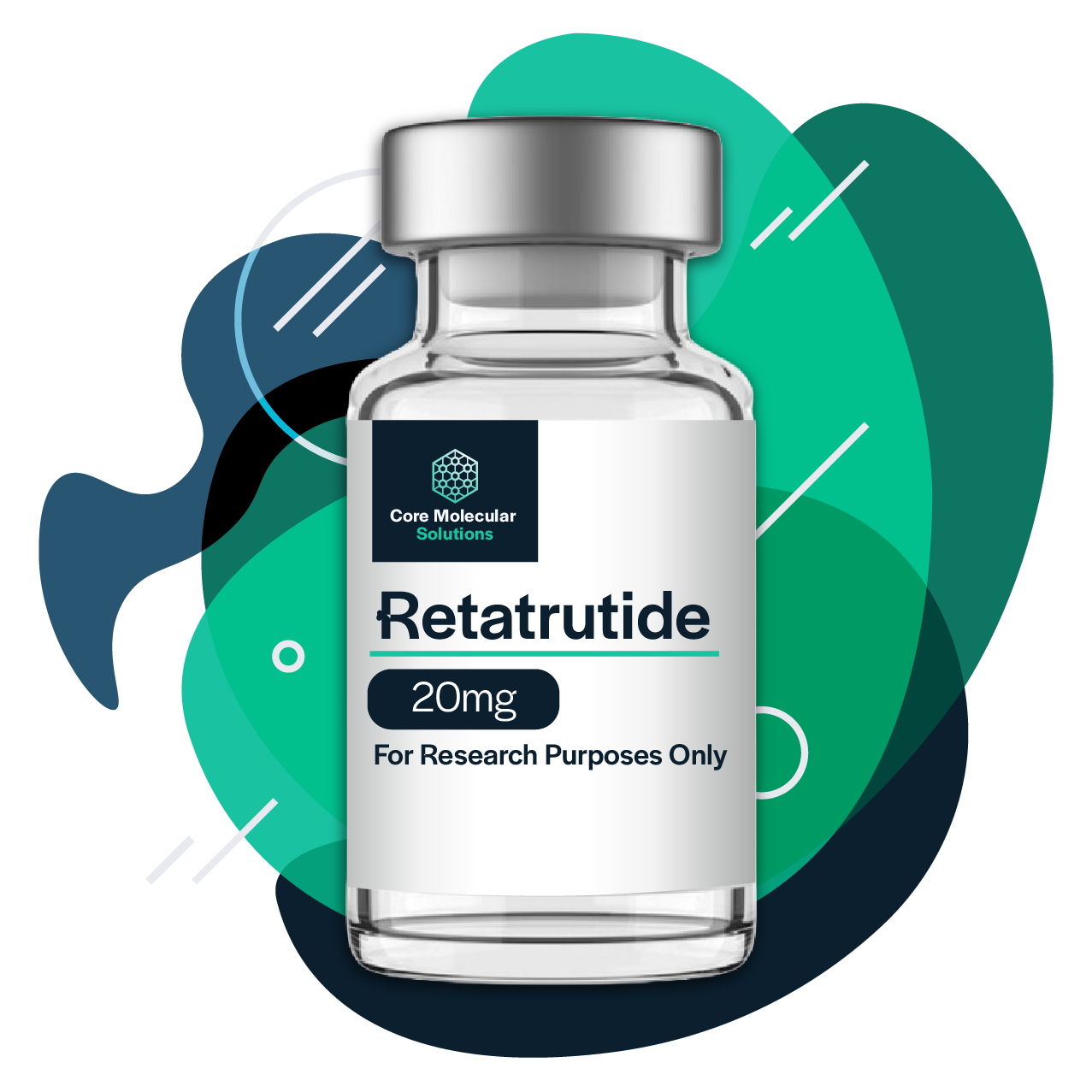
Retatrutide
Price range: $150.00 through $200.00
GLP-1 / GIP / Glucagon Triple Receptor Agonist · Lipidated Peptide
Retatrutide (LY3437943) is a synthetic 39-amino-acid engineered peptide designed for multi-receptor target engagement across the glucagon-like peptide-1 (GLP-1), glucose-dependent insulinotropic polypeptide (GIP), and glucagon (GCG) receptors. Incorporating a C₂₀ fatty-diacid side chain, it binds circulating serum albumin in vivo to yield an extended terminal half-life of approximately 6 days. Phase 1 and Phase 2 clinical trial literature (Rosenstock et al., 2023; Jastreboff et al., 2023) characterizes its triple-agonist pharmacology, evaluating its role in energy expenditure, hepatic lipid handling, and balanced incretin signaling.
Supplied at 20mg and 30mg
Description
Overview
Retatrutide is a synthetic 39-amino-acid engineered peptide designed to bind and activate three distinct metabolic hormone receptors: GLP-1R, GIPR, and GCGR. By integrating glucagon receptor agonism alongside incretin targets, Retatrutide offers a multi-pathway mechanism distinct from dual-agonist peptides.
The structure incorporates an α-aminoisobutyric acid (Aib) substitution for DPP-IV resistance and a specialized C₂₀ fatty-diacid acyl chain attached to a Lysine residue. This lipidation promotes reversible conjugation to circulating serum albumin, yielding an extended half-life of approximately 6 days in vivo.
Key Technical Specifications
| Sequence | HXQGTFTSDYSIXLDKIAQKAFVQWLIAGGPSSGAPPPS-NH2(X = Aib; Lys conjugated to γGlu-C20 diacid; C-terminal amide) |
|---|---|
| Molecular Formula | C₂₂₁H₃₄₂N₄₆O₆₈ |
| Molecular Weight | ~4731.3 g/mol |
| CAS Number | 2381089-83-2 |
| Elimination Half-Life | ~6 days (in vivo, human) |
| Solubility | Bacteriostatic Water / Sterile Water |
| Primary Class | Multi-Receptor Incretin / Glucagon Agonist |
Biochemical Architecture & Mechanisms
1. Balanced Triple-Receptor Potency
Retatrutide exhibits targeted activation across three distinct G-protein coupled receptors (GPCRs):
- GIP Receptor Agonism: High relative potency at GIPR drives potent glucose-dependent insulinotropic signaling.
- GLP-1 Receptor Agonism: Engages GLP-1R pathways involved in satiety modulation and postprandial signaling.
- Glucagon Receptor Agonism: Direct activation of GCGR contributes to increased energy expenditure, thermogenesis, and modified hepatic lipid handling.
2. Structural Stabilization & Albumin Conjugation
The introduction of non-canonical Aib residues protects the peptide backbone against enzymatic cleavage by Dipeptidyl Peptidase IV (DPP-IV). The C₂₀ diacid side chain binds tightly but reversibly to human serum albumin, creating a depot effect that minimizes renal clearance.
Nomenclature Clarification: Marketing literature occasionally references Retatrutide as “GLP-3.” However, no native GLP-3 receptor exists in human biology; the terminology refers to its triple action across GLP-1, GIP, and Glucagon receptors.
For laboratory research, educational, and analytical reference only. Strictly not for human or veterinary use.
Related products
-
AOD-9604
$100.00 Add to cart -

Semaglutide
Price range: $50.00 through $100.00 Select options This product has multiple variants. The options may be chosen on the product page -
TB-500
$130.00 Add to cart -
BPC-157
$70.00 Add to cart