

GHK-Cu
Price range: $50.00 through $80.00
Naturally Occurring Human Plasma Tripeptide Chelated with Copper(II)
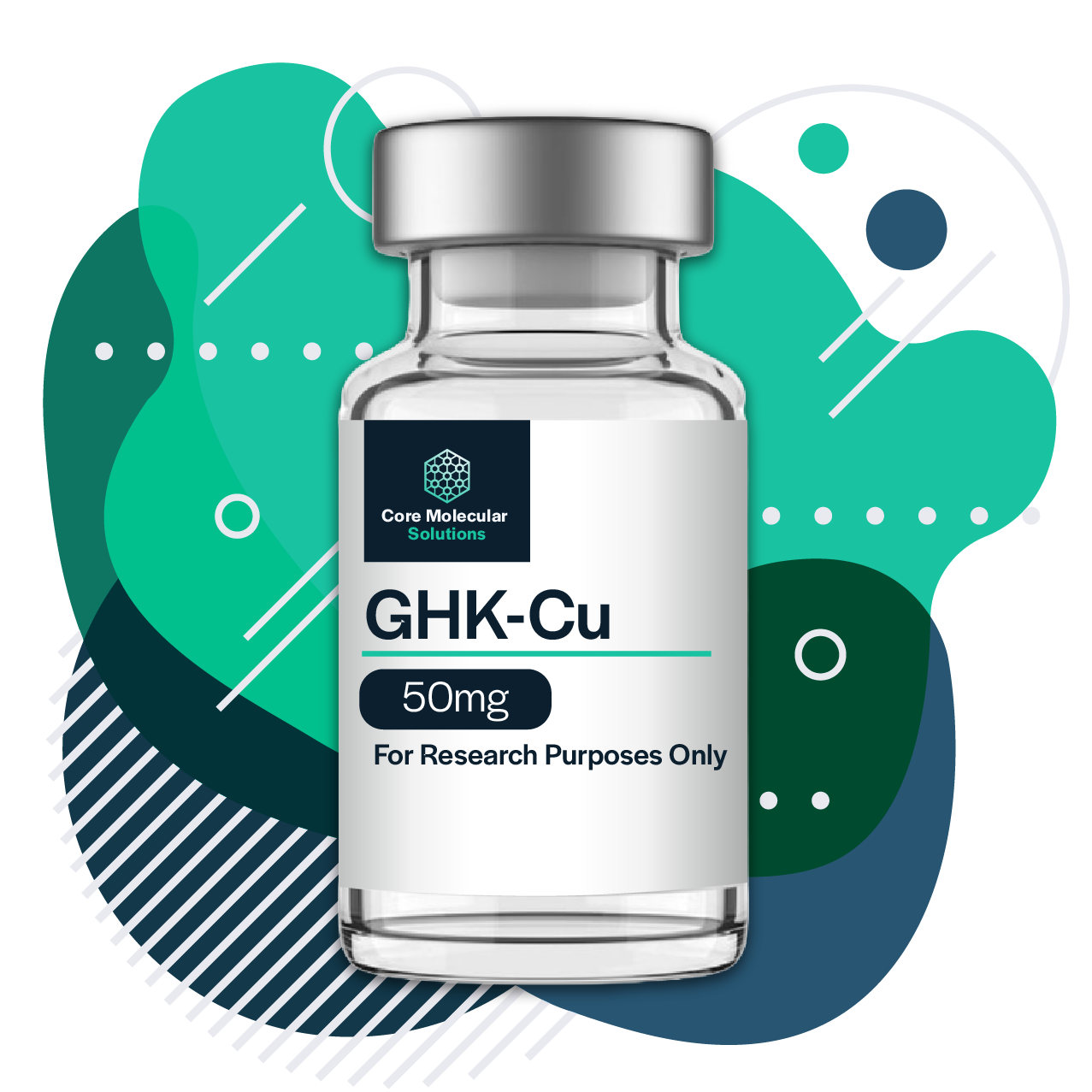
GHK-Cu is a naturally occurring peptide complex comprising the tripeptide Glycyl-L-Histidyl-L-Lysine bound to an ionic copper atom (Cu²⁺). First isolated from human plasma in 1973, GHK possesses a high binding affinity for copper, serving as a bio-available carrier complex. Extensive research focuses on its role in dermal biology, particularly its ability to stimulate skin fibroblast activity, promote extracellular matrix synthesis (collagen, elastin, and glycosaminoglycans), accelerate dermal wound healing, and modulate tissue remodeling and gene expression pathways.
Supplied at 50mg and 100mg.
Description
Overview
GHK-Cu (Glycyl-L-Histidyl-L-Lysine Copper) is a naturally occurring tripeptide-copper complex originally discovered in human blood plasma by Dr. Loren Pickart in 1973. Systemic plasma levels of GHK decline markedly with age—dropping from approximately 200 ng/mL at age 20 to 80 ng/mL by age 60.
Owing to its exceptionally high chelation affinity for copper(II) ions (Cu²⁺), GHK functions as an active signal peptide and specialized micro-carrier complex. It safely delivers bio-available copper to cellular environments without triggering oxidative stress, making it a primary focal point in research on dermal biology, extracellular matrix (ECM) synthesis, tissue regeneration, and cellular anti-aging pathways.
Key Technical Specifications
| Sequence | Gly-His-Lys-Cu²⁺ (Glycyl-L-Histidyl-L-Lysine) |
|---|---|
| Molecular Formula | C₁₄H₂₂CuN₆O₄ (free base complex) |
| Molecular Weight | ~401.91 g/mol |
| CAS Number | 89030-95-5 |
| INCI Name | Copper Tripeptide-1 |
| Physical State | Fine Blue Powder (due to chelated divalent copper ion) |
| Primary Class | Carrier / Signal Tripeptide Complex |
Biochemical Architecture & Mechanisms
1. High-Affinity Copper Chelation
The tripeptide sequence (Glycine-Histidine-Lysine) mimics natural high-affinity copper-binding active sites found on plasma proteins such as albumin. It tightly binds Cu²⁺ ions, shielding cellular structures from toxicity while permitting efficient receptor-mediated delivery into target tissue.
2. Extracellular Matrix (ECM) & Collagen Synthesis
GHK-Cu functions as a primary signaling molecule within dermal fibroblast biology:
- Structural Protein Upregulation: Markedly stimulates mRNA and protein expression of Type I and Type III Collagen, as well as elastin fibers.
- Glycosaminoglycan (GAG) Production: Increases the synthesis of dermal glycosaminoglycans, including hyaluronic acid, enhancing structural density, firmness, and moisture retention.
- Matrix Metalloproteinase Modulation: Balances the ratio of Matrix Metalloproteinases (MMPs) to Tissue Inhibitors of Metalloproteinases (TIMPs), fostering controlled tissue remodeling rather than aberrant scar formation.
3. Angiogenesis & Dermal Repair
- Wound Healing Acceleration: Acts as a chemoattractant for macrophages, mast cells, and capillary endothelial cells to site injuries, expediting re-epithelialization.
- Microvascular Support: Upregulates expression of Basic Fibroblast Growth Factor (bFGF) and Vascular Endothelial Growth Factor (VEGF) in tissue culture models to stimulate healthy capillary branching.
4. Genomic Regulation & Antioxidant Defense
- Gene Expression Profiling: Genomic studies indicate GHK-Cu modulates over 4,000 human genes—upregulating regenerative and tissue-repair pathways while downregulating pro-inflammatory cascades.
- Antioxidant System Activation: Supplies essential ionic copper required for the activation of Cu/Zn Superoxide Dismutase (SOD1), quenching free radicals and dampening lipid peroxidation.
Research & Application Note: GHK-Cu is extensively evaluated in dermatological studies focusing on skin barrier repair, wrinkle depth reduction, hair follicle enlargement (stimulating dermal papilla cells), and cellular responses to environmental stressors.
For laboratory research and formulation reference only.
Related products
-
Tirzepatide
Price range: $50.00 through $130.00 Select options This product has multiple variants. The options may be chosen on the product page -
NAD+
Price range: $80.00 through $130.00 Select options This product has multiple variants. The options may be chosen on the product page -
BPC-157
$70.00 Add to cart -
Retatrutide
Price range: $150.00 through $200.00 Select options This product has multiple variants. The options may be chosen on the product page