
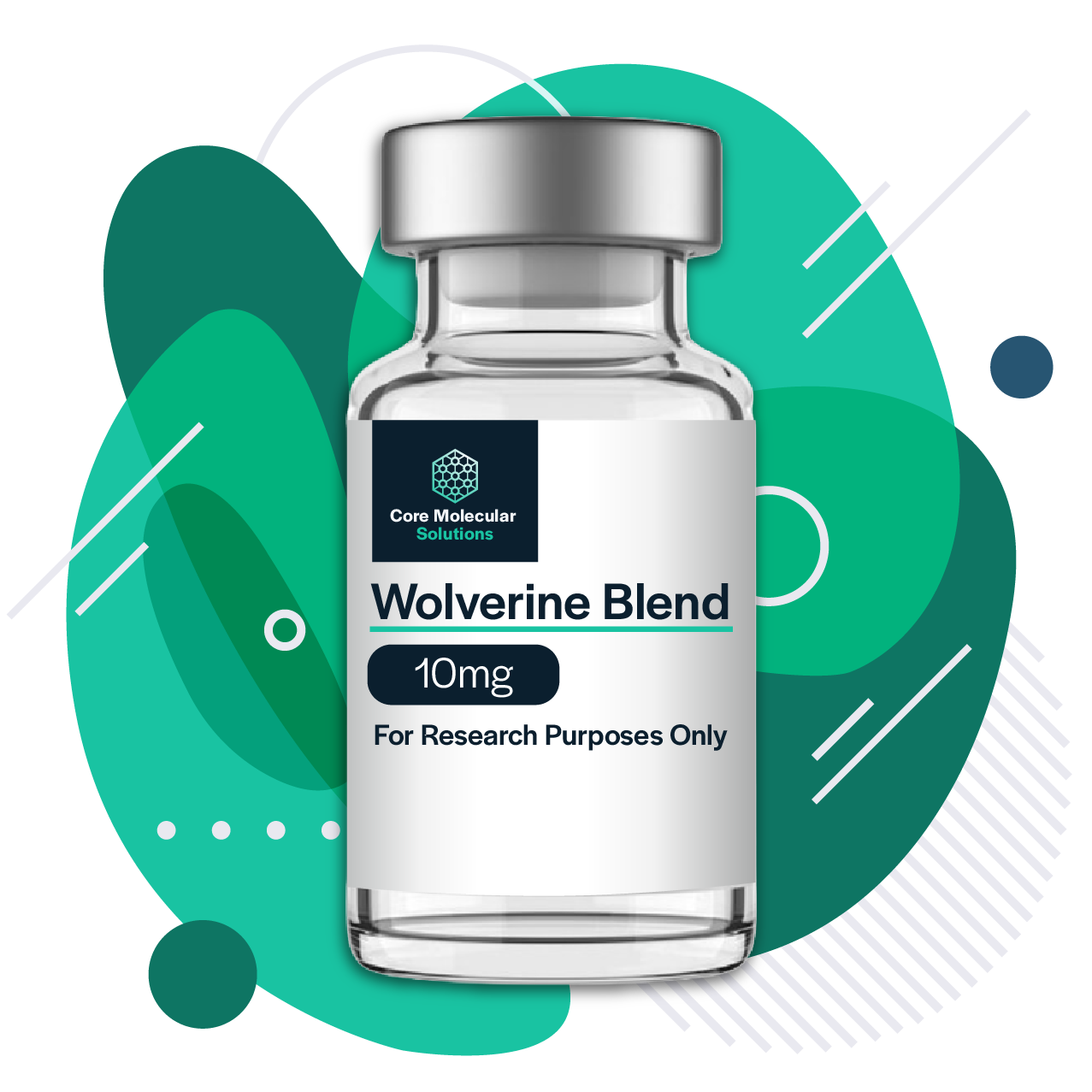
Wolverine Blend
Price range: $80.00 through $150.00
Synergistic Dual-Peptide Formulation · BPC-157 + TB-500
The Wolverine Blend is a co-formulated research complex combining equal mass ratios of BPC-157 (Pentadecapeptide, 15-aa) and TB-500 (Ac-LKKTETQ, 7-aa). Designed to explore convergent tissue-repair mechanics, this dual-peptide matrix pairs the cytoprotective, angiogenic, and nitric oxide-modulating properties of gastric Body Protection Compound fragment with the actin-sequestration, microfilament-remodeling, and cellular-migration dynamics of the active Thymosin β4 domain. Preclinical research evaluates this dual-action profile in connective tissue regeneration models, targeting fibroblast proliferation, focal adhesion kinase (FAK) activation, G-actin monomer pooling, and capillary sprouting across tendon, ligament, and osteochondral injury frameworks.
Supplied at 10mg and 20mg.
Description
Overview
The Wolverine Blend is a standardized co-formulation combining equal parts BPC-157 and TB-500. Designed for dual-action research into tissue regeneration, this matrix allows researchers to evaluate extracellular signaling and intracellular cytoskeletal dynamics simultaneously.
By pairing BPC-157’s angiogenic and cell-attachment properties with TB-500’s actin-sequestration and cell-motility mechanisms, the formulation provides a multi-target environment for studying complex tendon, ligament, and mucosal repair models.
Component Specifications
| Attribute | BPC-157 Component | TB-500 Component |
|---|---|---|
| Sequence | GEPPPGKPADDAGLV |
Ac-LKKTETQ-OH |
| Formula | C₆₂H₉₈N₁₆O₂₂ | C₃₈H₆₈N₁₀O₁₄ |
| Mol. Weight | ~1419.55 g/mol | ~889.02 g/mol |
| CAS Number | 137525-51-0 | 885340-08-9 |
| Half-Life | ~30 min (rodent) | Rapid distribution |
| Solubility | Bacteriostatic Water / Sterile Water | |
Synergistic Research Mechanics
1. Angiogenesis & Capillary Formation
- Signal Initiation (BPC-157): Induces VEGF upregulation to stimulate new vessel formation at injury sites.
- Structural Assembly (TB-500): Promotes directional movement and tube alignment of endothelial cells to establish functioning capillary networks.
2. Extracellular Matrix (ECM) & Fibroblast Repair
- FAK Axis Activation: BPC-157 phosphorylates focal adhesion kinase, improving fibroblast adherence and collagen scaffolding synthesis.
- G-Actin Pooling: TB-500 maintains monomeric actin reserves needed for rapid cellular migration and microfilament structural movement.
Formulation Ratios: Standardized in 1:1 mass formulations—10mg total (5mg BPC-157 / 5mg TB-500) and 20mg total (10mg BPC-157 / 10mg TB-500)—ensuring precise molar balance for multi-pathway research designs.
For laboratory research, educational, and analytical reference only. Strictly not for human or veterinary use.