


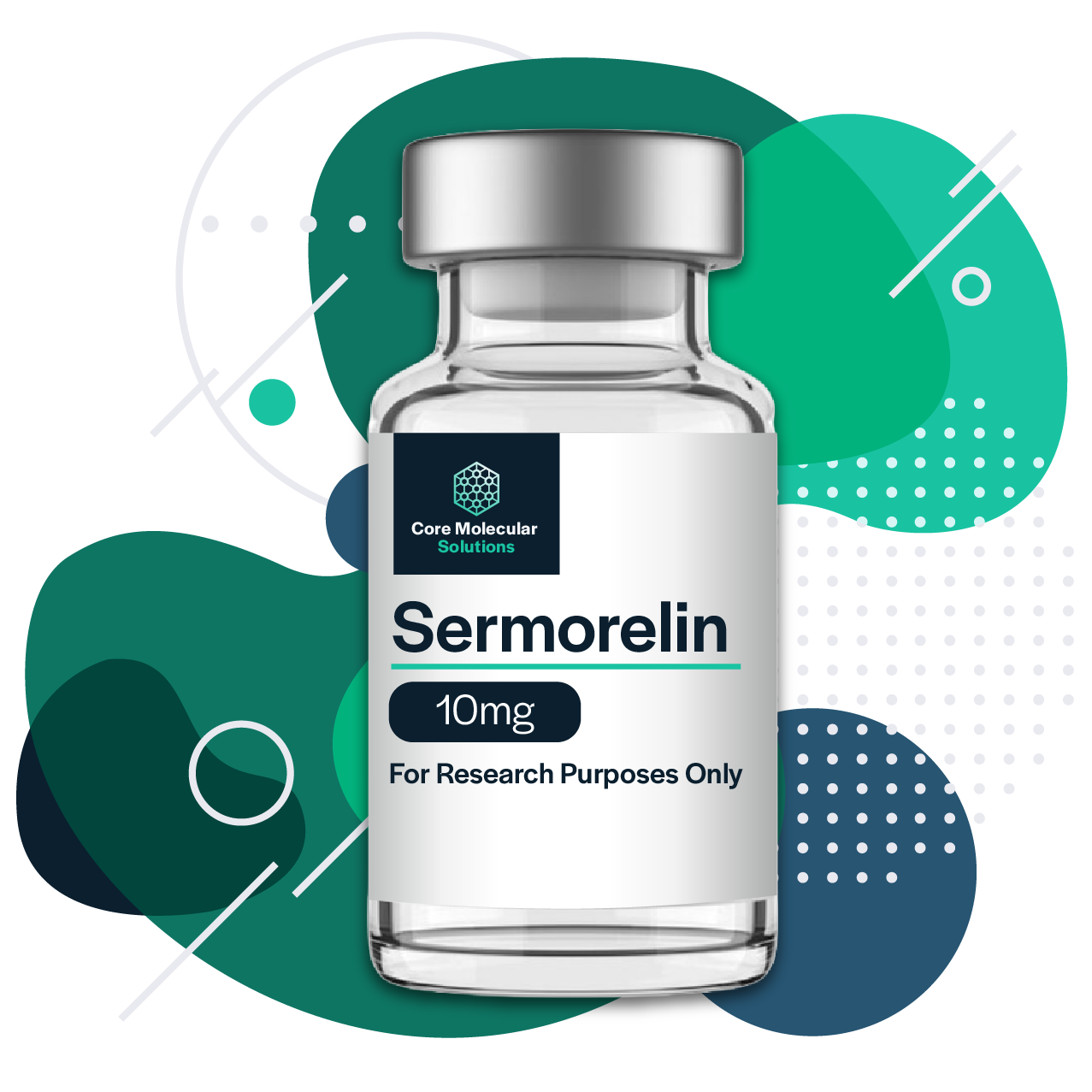
Sermorelin
$100.00
Truncated GHRH(1–29) Analog · 29-Amino-Acid Synthetic Polypeptide
Sermorelin (Tyr-Ala-Asp-Ala-Ile-Phe-Thr-Asn-Ser-Tyr-Arg-Lys-Val-Leu-Gly-Gln-Leu-Ser-Ala-Arg-Lys-Leu-Leu-Gln-Asp-Ile-Met-Ser-Arg-NH2) is a synthetic 29-amino-acid polypeptide representing the truncated 1–29 N-terminal sequence of endogenous Growth Hormone-Releasing Hormone (GHRH1–44). Developed in the 1970s following pioneering research in Roger Guillemin’s laboratory — work that earned a portion of the 1977 Nobel Prize in Physiology or Medicine — this 29-residue fragment was identified as the shortest functional sequence capable of retaining full receptor affinity and biological activity of native GHRH. Sermorelin acts as a selective agonist at the GHRH receptor on pituitary somatotrophs, stimulating the synthesis and pulsatile release of endogenous growth hormone (GH), which subsequently drives hepatic secretion of Insulin-like Growth Factor 1 (IGF-1). Pharmacokinetic profiling demonstrates a rapid systemic elimination half-life (~10–20 minutes in human models) due to enzymatic cleavage by dipeptidyl peptidase IV (DPP-IV), making it an established reference standard and physiological probe for assessing somatotropic axis function.
Supplied at 10mg.
Description
Truncated GHRH(1–29) Analog · 29-Amino-Acid Synthetic Polypeptide
Sermorelin is a synthetic 29-amino-acid peptide corresponding to the amino-terminal sequence of human Growth Hormone-Releasing Hormone (GHRH1–44). Discovered in Roger Guillemin’s Nobel Prize–winning laboratory, it represents the shortest fully functional fragment of endogenous GHRH capable of activating pituitary GHRH receptors.
By binding selectively to pituitary somatotrophs, Sermorelin stimulates the cyclic AMP–dependent synthesis and release of natural growth hormone (GH), subsequently driving downstream hepatic IGF-1 expression while preserving endogenous negative feedback loops.
Key Technical Specifications
| Sequence | YADAIFTNSYRKVLGQLSARKLLQDIMSR-NH2 |
|---|---|
| Molecular Formula | C₁₄₉H₂₄₆N₄₄O₄₂S |
| Molecular Weight | ~3357.88 g/mol |
| CAS Number | 86168-78-7 |
| Elimination Half-Life | ~10–20 minutes (in vivo, human) |
| Solubility | Bacteriostatic Water / Sterile Water |
| Primary Class | GHRH Receptor Agonist / Truncated GHRH Analog |
Biochemical Architecture & Mechanisms
1. Pituitary Signal Transduction
Sermorelin binds to the extracellular domain of GHRH receptors on anterior pituitary somatotrophs, activating G-protein signaling, increasing intracellular cAMP, and inducing calcium ion influx to trigger secretory exocytosis of growth hormone.
2. Downstream Somatotropic Axis Activation
- Endogenous Pulsatility: Stimulates pulsatile GH release rather than continuous receptor saturation, respecting natural circadian secretory profiles.
- IGF-1 Induction: Circulating GH stimulates hepatic production of Insulin-like Growth Factor 1 (IGF-1), driving anabolic and tissue-remodeling signaling pathways.
- Rapid Enzymatic Clearance: Cleaved rapidly by circulating DPP-IV enzymes, creating a controlled, short-lived pharmacological window.
Preclinical Literature: Research confirms Sermorelin’s utility as a sensitive diagnostic probe for somatotroph reserve testing and a primary baseline reference for evaluating long-acting modified GHRH derivatives.
For laboratory research, educational, and analytical reference only. Strictly not for human or veterinary use.
Related products
-
CJC-1295 DAC
$140.00 Add to cart -
MOTS-C
Price range: $50.00 through $150.00 Select options This product has multiple variants. The options may be chosen on the product page