

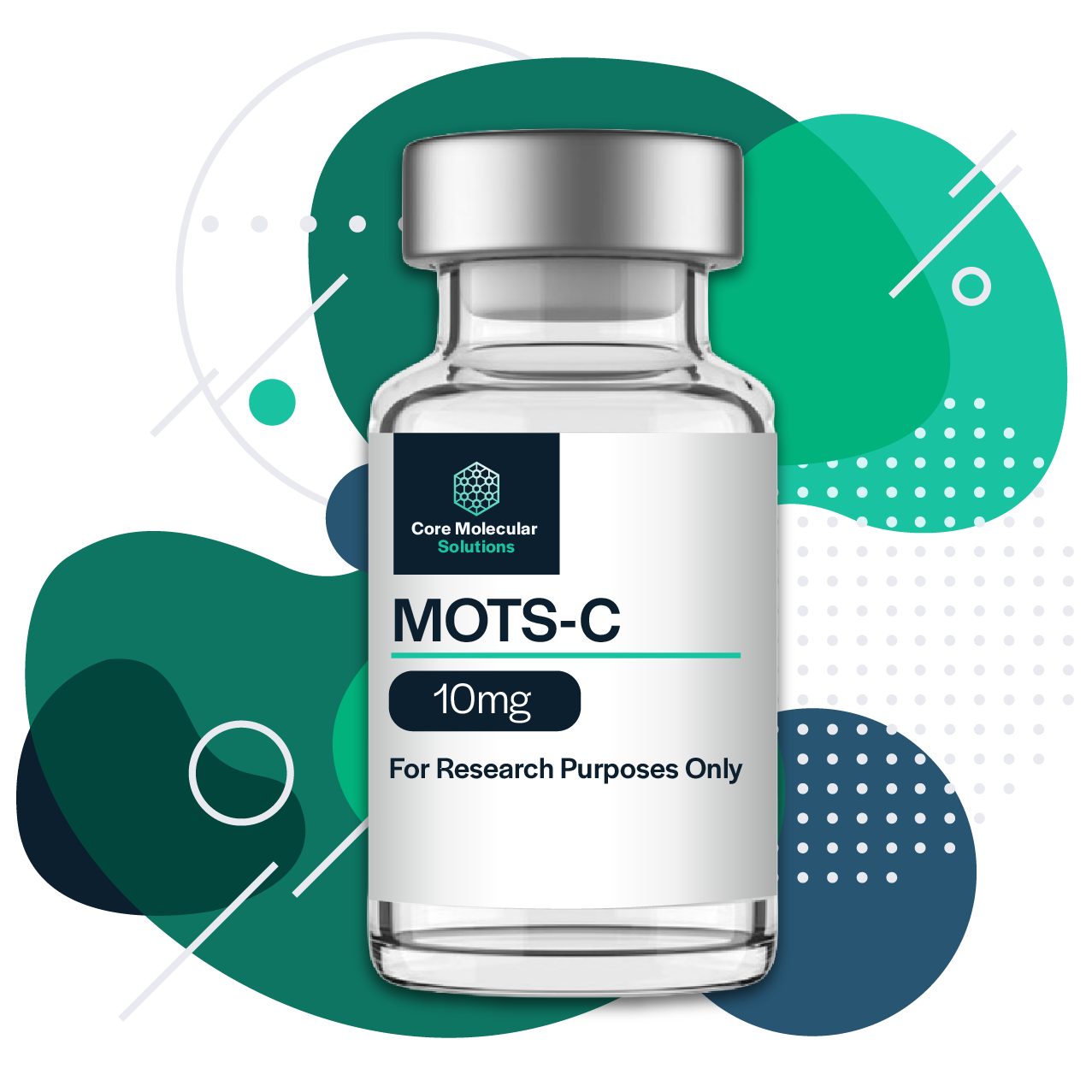
MOTS-C
Price range: $50.00 through $150.00
Mitochondrial-Derived Peptide (MDP) · 16-mer Exercise Mimetic
MOTS-c (Mitochondrial Open Reading Frame of the 12S rRNA Type-c) is a naturally occurring 16-amino-acid peptide encoded within the mitochondrial genome rather than nuclear DNA. Discovered in 2015, MOTS-c functions as an essential mediator of mitochondrial-to-nuclear retrograde signaling. Under conditions of metabolic stress or exercise, MOTS-c translocates to the nucleus to regulate metabolic homeostasis. Preclinical literature characterizes its targeted activation of the AMPK (AMP-activated protein kinase) signaling axis, driving intracellular glucose uptake, enhancing insulin sensitivity, regulating lipid oxidation, and modulating skeletal muscle energy dynamics without relying on upstream insulin receptor signaling.
Supplied at 10mg and 40mg.
Description
Overview
MOTS-c (Mitochondrial Open Reading Frame of the 12S rRNA Type-c) is a 16-amino-acid peptide encoded within the mitochondrial DNA genome. Discovered in 2015, it acts as a primary signaling molecule in mitochondrial retrograde signaling, communicating cellular energy conditions directly to the nucleus.
In preclinical research, MOTS-c translocates to the cell nucleus during metabolic stress to regulate energy homeostasis. It activates the AMPK signaling pathway, promoting insulin-independent glucose uptake, enhanced fatty acid oxidation, and improved metabolic flexibility in skeletal muscle models.
Key Technical Specifications
| Sequence | MRWQEMGYIFYPRKLR |
|---|---|
| Molecular Formula | C₁₀₁H₁₅₂N₂₈O₂₂S₂ |
| Molecular Weight | ~2174.60 g/mol |
| CAS Number | 1627580-64-6 |
| Elimination Half-Life | Rapid cellular distribution / short plasma clearance |
| Solubility | Bacteriostatic Water / Sterile Water |
| Primary Class | Mitochondrial-Derived Peptide (MDP) / Metabolic Regulator |
Biochemical Architecture & Primary Mechanisms
1. Mitochondrial Retrograde Signaling
Under metabolic stress or physical activity, MOTS-c translocates from the cytoplasm to the nucleus. Inside the nucleus, it interacts with transcription factor complexes (including Nrf2) to modulate nuclear gene expression linked to energy production and cellular defense.
2. AMPK Pathway Activation & Folate Inhibition
MOTS-c targets the folate cycle to increase intracellular AICAR levels, directly stimulating AMP-activated protein kinase (AMPK):
- GLUT4 Translocation: Triggers GLUT4 glucose transporter movement to muscle cell membranes, driving insulin-independent glucose uptake.
- Fatty Acid Oxidation: Accelerates lipid metabolism and mitochondrial respiration in skeletal muscle.
Preclinical Literature: Research published in Cell Metabolism (Lee et al., 2015) and Nature Communications (Reynolds et al., 2021) highlights MOTS-c as a critical “exercise mimetic” capable of reversing age-dependent and diet-induced insulin resistance.
For laboratory research, educational, and analytical reference only. Strictly not for human or veterinary use.