


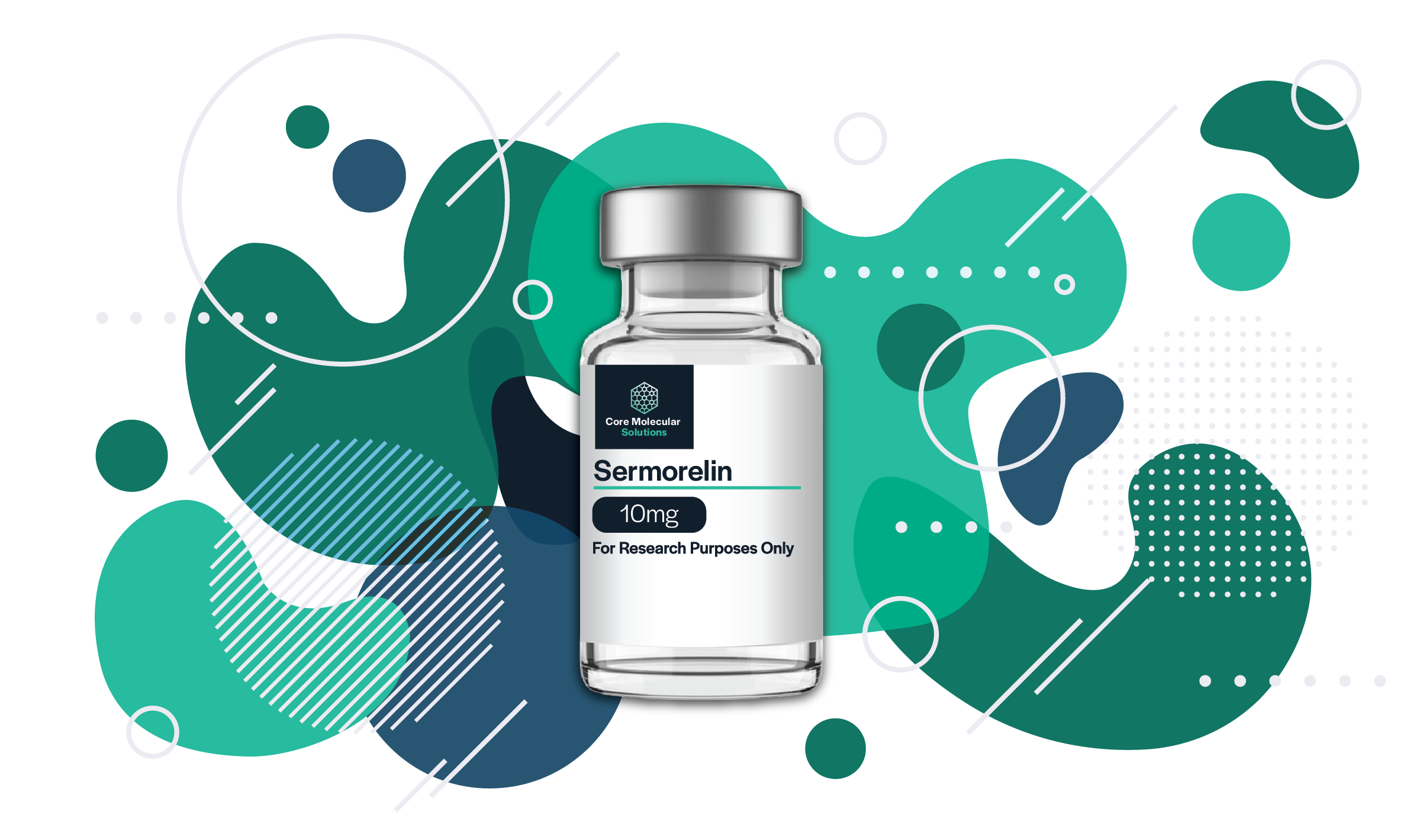
Sermorelin: What the Research Shows
Sermorelin is a synthetic peptide corresponding to the first 29 amino acids of human growth hormone-releasing hormone (GHRH) — the active fragment responsible for GHRH’s biological effect. Unlike growth hormone itself, sermorelin works upstream: it stimulates the pituitary gland to release the body’s own growth hormone, preserving the natural pulsatile release pattern rather than producing a sustained, non-physiological elevation the way direct GH administration does.
Reversing Age-Related GH Decline
The foundational study on sermorelin in aging, published in the Journal of Clinical Endocrinology & Metabolism, compared 9 young men (ages 22-33) against 10 elderly men (ages 60-78). Researchers gave the elderly men twice-daily subcutaneous sermorelin for 14 days and found it restored growth hormone pulse amplitude and 24-hour integrated GH concentration toward young-adult reference values, with IGF-1 rising in parallel. Notably, elevated IGF-1 levels persisted for up to two weeks after treatment stopped (Corpas et al., Growth hormone-releasing hormone-(1-29) twice daily reverses the decreased GH and insulin-like growth factor-I levels in old men, JCEM, 1992).
Body Composition
Sleep and Cognitive Function
A separate study took a different angle, examining sermorelin’s effects on sleep architecture and memory in healthy older men. Researchers found that GHRH administration was associated with improvements in both sleep quality and memory performance — one of the few studies in this research area to look beyond body composition and metabolic markers toward cognitive and sleep-related outcomes (Vitiello, Moe, Merriam, & Prinz, Sermorelin, a growth hormone-releasing hormone analogue, improves sleep and memory in healthy older men, Sleep, 1997).

Proposed Mechanism
Research on sermorelin points to a mechanism distinct from direct growth hormone administration:
- Pituitary-level stimulation — sermorelin acts on GHRH receptors in the anterior pituitary, prompting the gland to release the body’s own stored growth hormone rather than introducing exogenous GH directly
- Preserved pulsatility — because sermorelin works through the body’s existing regulatory system, natural feedback mechanisms (via somatostatin and IGF-1) remain intact, distinguishing it mechanistically from recombinant GH therapy
- Short circulating half-life — native GHRH(1-29) is rapidly broken down by the enzyme DPP-4, which is part of why longer-acting modified analogs like CJC-1295 were later developed
Current State of the Evidence
The research above centers on small, short-to-medium duration studies (14 days to 6 months) in older adults, primarily measuring hormonal and body composition markers. Larger-scale, longer-duration controlled trials remain limited.
Explore our Sermorelin research product:
View SermorelinThis overview reflects published clinical research. Products offered by Core Molecular Solutions are intended for laboratory research purposes only and are not for human or veterinary use.